CV/Cdl: Double-Layer Capacitance and Electrochemically Active Surface Area Analysis
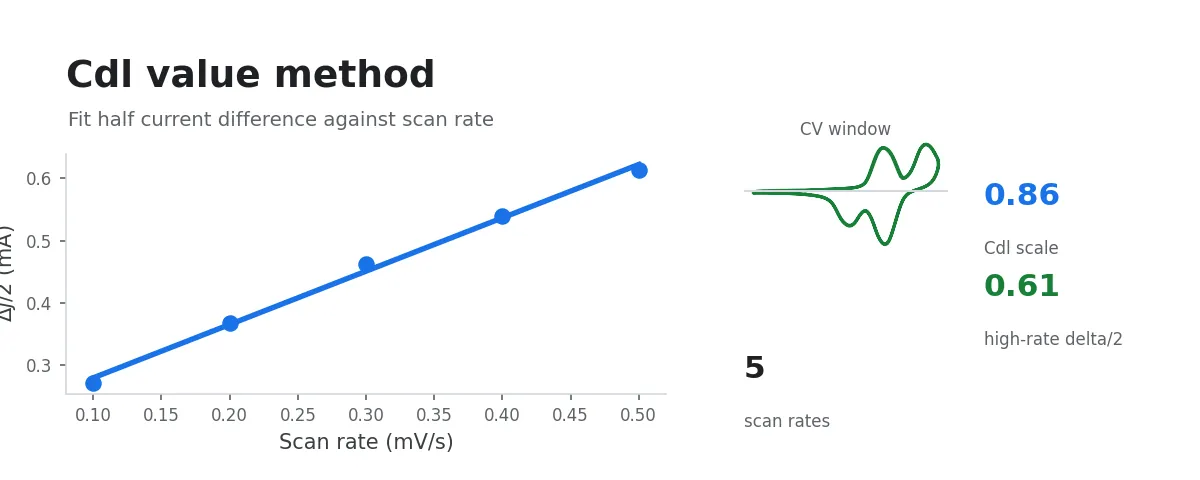
This workflow uses CV data recorded at different scan rates to obtain the double-layer capacitance through linear fitting of the difference between anodic and cathodic currents at the midpoint potential, which can be further used to calculate the electrochemically active surface area (ECSA).
Input Data
Select a folder containing instrument-exported raw CV data, or multi-select a group of raw CV data files.
The dataset should contain CV curves at multiple different scan rates for a reliable linear fit.
Procedure
- Select input data: choose a folder containing CV data at different scan rates, or multi-select a group of data files.
- The system automatically calculates values at each scan rate, performs linear fitting, and generates a fitting plot.
Scientific Principles
Determination of Double-Layer Capacitance
In the non-Faradaic potential region, only double-layer charging and discharging occurs at the electrode surface. Under these conditions, the charging current is proportional to the scan rate :
In practice, the average of the absolute values of the anodic current and cathodic current at the midpoint potential is taken as the approximate double-layer charging current at that scan rate:
where is defined as:
Linear Fitting
A linear fit is performed with on the x-axis and on the y-axis:
The slope of the fit yields the double-layer capacitance (unit: F). Ideally, the intercept should approach zero.
Electrochemically Active Surface Area
Given the specific capacitance (unit: ) of a particular electrode material in a specific electrolyte, the ECSA can be calculated as:
A common reference value: the of a smooth metal electrode surface is typically taken as –.
Output
- Linear fitting plot: The x-axis is scan rate (V/s), and the y-axis is (A). The plot includes experimental data points (scatter) and the least-squares fitting line, annotated with the value and .
- Result files are saved to the output folder.
Related Workflows
- CV/Pseudocapacitance Analysis: b-Value Kinetic Analysis: detects multiple peaks and groups them across scan rates, fitting a power-law value separately for each valid peak group; purely capacitive samples fall back to the midpoint current.
- CV: Coulombic Efficiency and Capacitance Calculation: evaluates the reversibility of electrode reactions from the perspective of charge