CV: Coulombic Efficiency and Capacitance Calculation
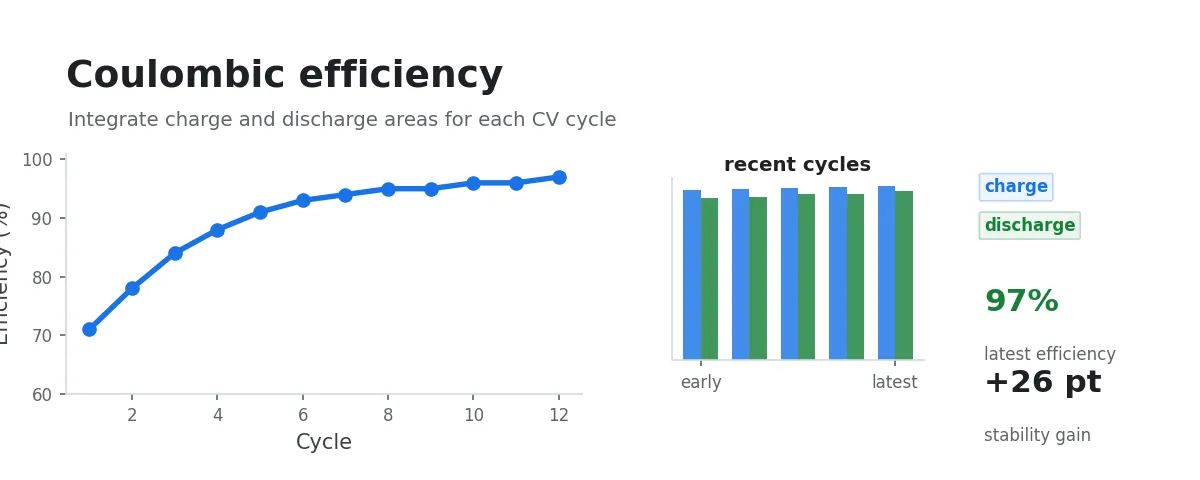
This workflow uses a set of CV data to calculate the charge passed during the forward scan and reverse scan of each cycle via numerical integration, yielding coulombic efficiency and electrode capacitance.
Input Data
Select a folder containing instrument-exported raw CV data, or multi-select a group of raw CV data files.
This workflow integrates complete forward/reverse cycles, so the data should contain recognizable forward and reverse scan segments.
Procedure
- Select input data: choose a folder containing CV data, or multi-select a group of files from the same experiment. The dataset typically contains CV curves recorded at different scan rates.
- The system automatically completes the calculations and generates result files and visualization plots.
Scientific Principles
Charge Calculation
By definition of current, the charge is the integral of current over time . For discrete data, numerical integration is performed using the trapezoidal rule:
where the time step is derived from the sample interval and scan rate:
Here, is the sampling potential interval (V), and is the scan rate (V/s).
Coulombic Efficiency
Coulombic efficiency (CE) is defined as the ratio of the charge passed during the reverse scan (reduction process) to the charge passed during the forward scan (oxidation process):
This metric reflects the degree of reversibility of the electrode process. For an ideal, fully reversible process, the coulombic efficiency should approach 100%.
Capacitance Calculation
For electrode materials exhibiting capacitive behavior, the capacitance is defined as the ratio of charge to the potential window :
where and are the upper and lower limits of the scan potential window, respectively.
Output Files
Upon completion, a Coulombic_Efficiency.xlsx file is generated containing the following two worksheets:
Summary_Stats
Coulombic efficiency and capacitance statistics (mean and standard deviation) grouped by scan rate, used for evaluating the repeatability and stability of the test data.
Detailed_Per_Cycle
Detailed calculation results for each cycle in each file:
| Field | Description |
|---|---|
| Q_Forward / Q_Reverse | Forward/reverse scan charge (C) |
| CE (%) | Coulombic efficiency |
| Cap_Forward / Cap_Reverse | Forward/reverse scan capacitance (F) |
| Cap_Avg | Average capacitance (F) |
Subsequent Analysis
Based on the same CV dataset, you can proceed with pseudocapacitance analysis such as CV/Pseudocapacitance Analysis: b-Value Kinetic Analysis or CV/Cdl: Double-Layer Capacitance and Electrochemically Active Surface Area Analysis.